
AI Training for Employees: Add a Source Freshness Check
AI training for employees should teach a source-freshness check: the right document can still be obsolete, out of scope or already replaced.
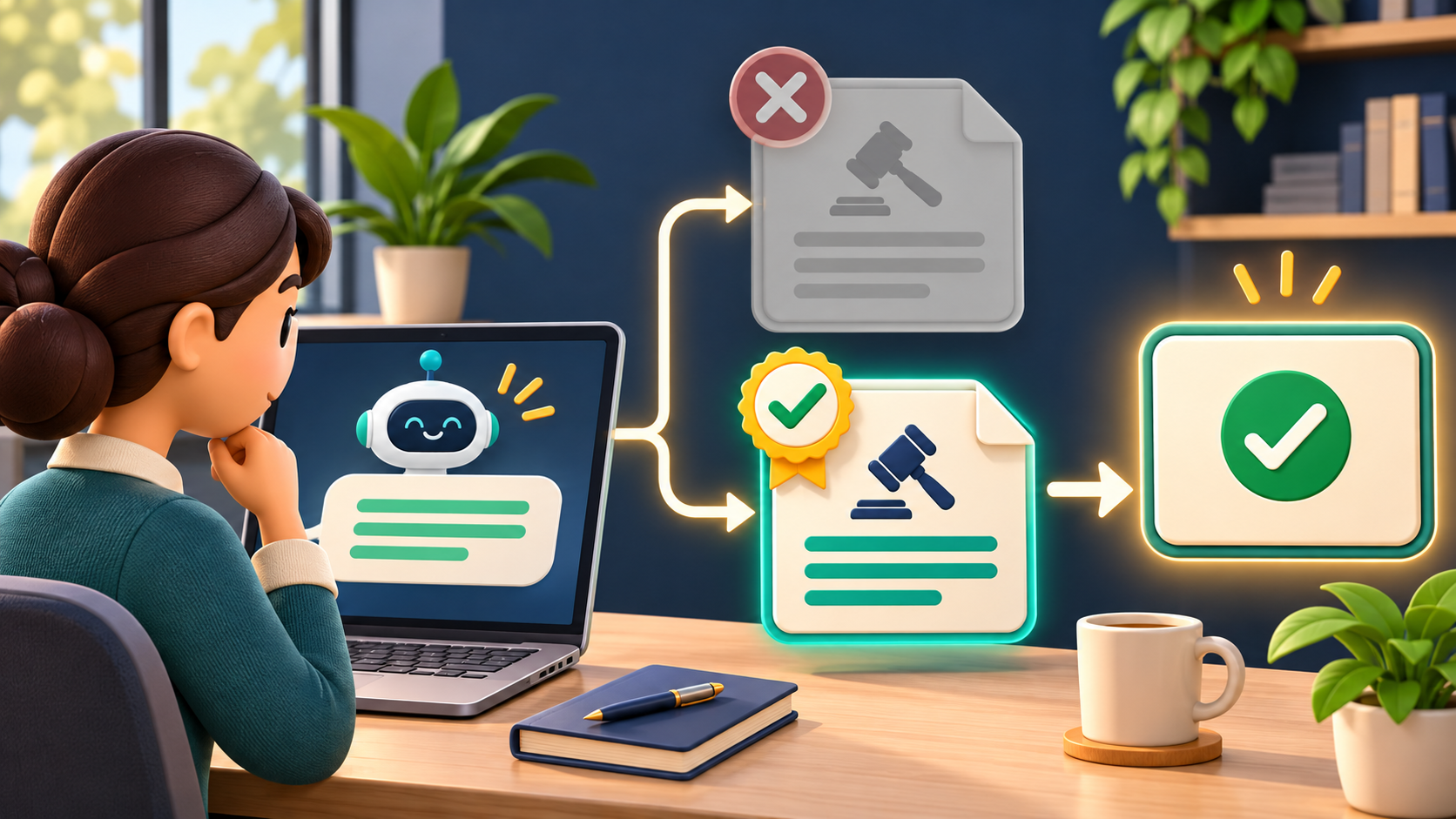
AI training for employees often teaches source checking: open the citation, find the supporting passage and compare it with the answer. That is necessary, but it misses a common failure. The source may genuinely support the claim and still be too old, superseded, written for another region or outside the period covered by the decision.
A source-freshness check adds one small habit before an AI answer becomes work. The employee confirms the document’s date and version, the scope it applies to, the owner or approved repository, and any sign that a newer source has replaced it. This is not a request for every learner to become a records manager. It is a practical way to stop a fluent answer from giving obsolete guidance new authority.
Why AI training for employees needs a freshness check
Generative AI can summarise an old policy accurately. It can quote a superseded procedure faithfully. It can combine a current global rule with an expired local exception and produce a clean answer that no one has actually approved. Accuracy to the provided text is not the same as fitness for today’s task. The UK Government Data Quality Framework treats timeliness as a question of whether information reflects the right period for its intended use. That distinction belongs in workplace AI practice.
| Source supports the words | Source is fit for the decision | |
|---|---|---|
| Evidence | The passage matches the claim | The passage matches and is current |
| Scope | Document appears relevant | Region, role, product and audience match |
| Authority | File looks official | Owner or approved repository is confirmed |
| Change | No contradiction noticed | Replacement, expiry and review signals are checked |
Use the DATE source-freshness check
DATE: four checks before you use the answer
D — Date and version
Find the effective date, last review date or version. A filename alone is not reliable proof.
A — Applicability
Confirm the source covers the right region, business unit, role, product and period for this task.
T — Trusted owner
Open the approved repository or ask the named owner. Do not assume the newest search result is authoritative.
E — Evidence of replacement
Look for an archive label, redirect, change notice, newer policy or linked amendment. If status is unclear, stop and route the question.
Reading is a start. Practice makes it stick.
Start learningWorked example: two expense policies, one polished answer
An employee asks an AI assistant for the hotel limit on a customer visit. The answer cites a PDF and quotes a clear amount. The PDF is real, but its footer says version 3.1 and the intranet policy page now links to version 4.0. The newer policy uses a different limit for the employee’s region and requires manager approval above it. The original answer was well grounded in the wrong version. DATE changes the action: the employee records the current version, checks regional scope, uses the approved intranet owner and keeps the approval condition in the final message.
Source-freshness signals employees can see
- Effective, published or last-reviewed date
- Version number or change history
- Region, role, product or audience scope
- Named policy or data owner
- Approved repository or source-of-truth page
- Archive, expiry or superseded label
- Redirect or link to a replacement
- Review trigger when status is unclear
A ten-minute source-freshness exercise
- Choose two approved or synthetic versions of one simple policy.
- Ask an AI tool to answer one practical question using the older version.
- Open the cited passage and confirm that it really supports the answer.
- Run DATE: version, applicability, trusted owner and replacement evidence.
- Repeat with the current version and note what changes in the action.
- Write the escalation sentence to use when the active source cannot be confirmed.
Design the lesson around the visible behaviour
Do not score learners for memorising the word DATE. Give them a realistic answer and a source pack with one subtle freshness signal. A pass means they open the source, identify the current version, confirm scope and choose the correct route when authority is uncertain. The UK AI Playbook emphasises lifecycle management and ongoing monitoring; European Commission guidance tells users to verify important information against trusted or official sources. The workplace version is simple: trusted must also mean current and applicable.
This article supports Bokili’s practical learning approach. Pair it with an input-pack audit, a one-claim source test and a visible review standard. Together they teach employees to ask not only “Can I prove this sentence?” but “Can this source govern this decision today?”
Practise this in Bokili
Turn what you just read into a ten-minute mission.
- Start learning
Explore Bokili for workplace AI practice
Build role-relevant AI skills through short, practical missions.
- Start learning
Audit the Input Pack First
Check whether the supplied material is complete and fit for the task.
- Start learning
Test One Claim Against One Source
Narrow the evidence set before you expand it.
- Start learning
Keep the Review Standard Visible
Separate stable standards, current sources and today’s request.
Sources
- The Government Data Quality Framework — UK Government
- The Government Data Quality Framework: guidance — UK Government
- Artificial Intelligence Playbook for the UK Government — Government Digital Service
- Making artificial intelligence work for people — European Commission
Reading is a start. Practice makes it stick.
Bokili turns skills like this into ten-minute missions for your whole team, with instant feedback and progress you can see.
Start learningKeep reading

AI Training for HR: Keep Health Inference Out of Absence Summaries
Train HR teams to produce a minimal operational absence summary without exposing health details, inventing causes or letting AI make a people decision.

Allocate AI Licences to Task-Ready Work, Not Waiting Lists
Use four readiness gates to allocate scarce AI access to work with an approved input, clear outcome, review owner and support route.

AI Skills for Employees: Calibrate Confidence Before Checking
Train employees to record confidence before AI advice, verify the decisive claim and learn from the gap between prediction and evidence.