
Before an AI Output Travels, Run a Second-Use Check
A reviewed AI-assisted output is approved for one purpose. Use the SECOND card before it moves to a new audience, decision or consequence.
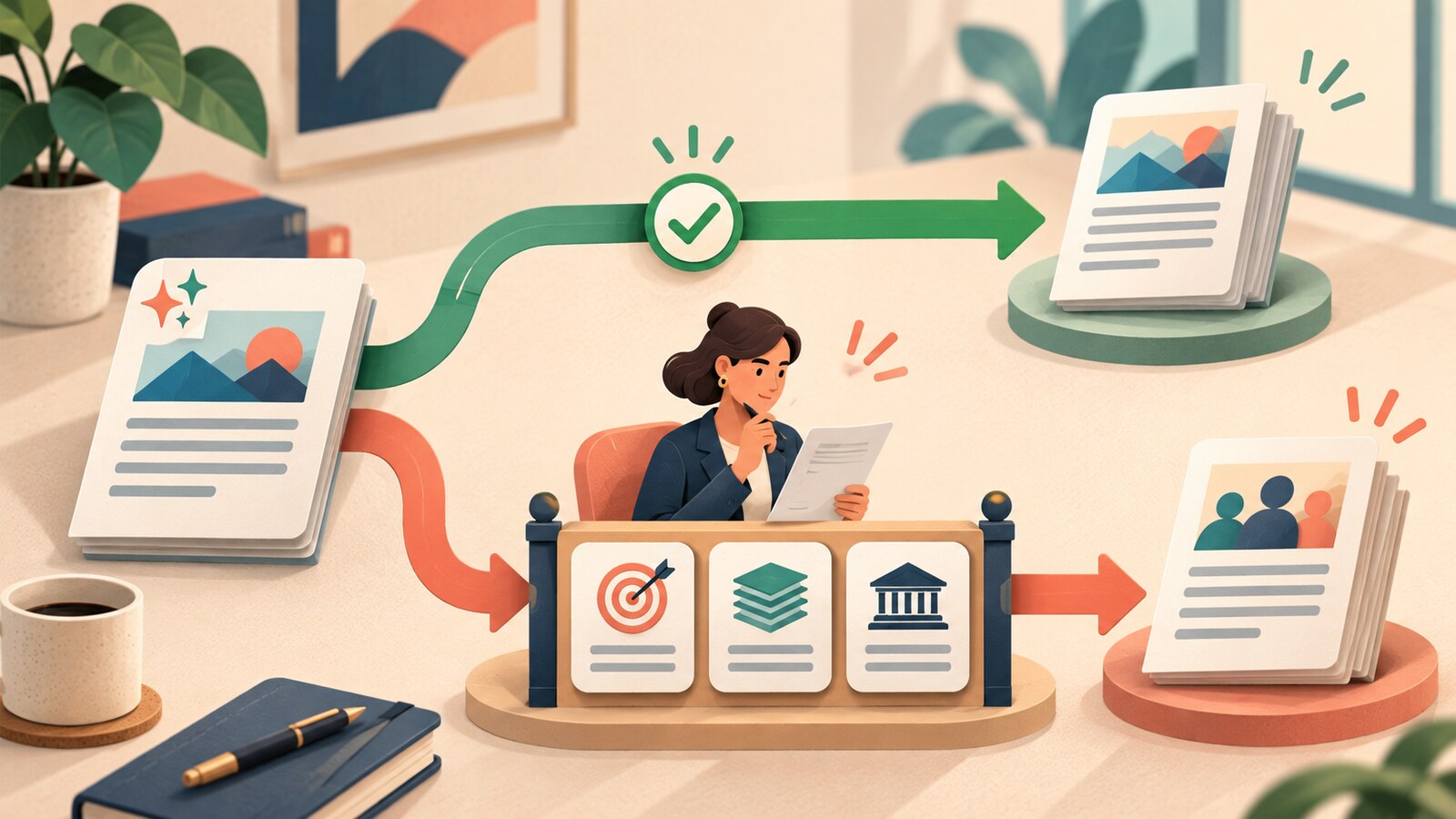
A reviewed AI-assisted output is not approved for every later use. A supplier summary checked for an internal meeting may be copied into a board paper, a client email or a procurement decision. The words may not change, but the audience, consequence and authority do. That is a second use, and it deserves a fresh, proportionate check.
This matters because verification is contextual. NIST’s AI Risk Management Framework playbook asks organisations to define the intended purpose, users, operating setting and human oversight around an AI system. It also warns that broadly deployed tools will be reused and repurposed. The UK Government AI Playbook makes the same practical point: people need meaningful human control at the right stage, especially when impact rises.
Use the SECOND check before an AI output travels
SECOND: six fields for a second-use review
Scope
Name the original task and the new task. If the output now supports a different decision, treat it as a new use.
Evidence
Confirm that the sources still cover the claim, date range and geography required by the new use.
Context
Check the new audience, channel, timing and surrounding information. A true statement can still mislead outside its original context.
Owner
Name the person authorised to approve the new use. The first reviewer may not own the second decision.
New risk
Ask what new harm, commitment or misunderstanding becomes possible when the output travels.
Decision
Record reuse, revise, re-check with a specialist, or do not use. Keep the reason with the output.
The check is deliberately small. It does not demand a full audit every time someone quotes a low-stakes draft. It asks whether the original review still fits. When purpose, audience, evidence or consequence changes, the answer may be no even if every sentence remains identical.
Worked example: an internal supplier brief becomes a customer promise
A procurement analyst uses an approved AI tool to summarise three fictional supplier updates. The analyst checks the delivery dates against the source notes and prepares a short internal brief for a weekly operations meeting. The brief says a component is “expected in early December”. For internal planning, the wording is acceptable because the source is clearly labelled as a supplier estimate and the operations lead knows the uncertainty.
A sales colleague later copies the sentence into a customer email and changes “expected” to “will arrive”. The source has not changed, but the use has. The audience now treats the sentence as a commitment. The sales colleague is not the owner of the supplier forecast, and the customer decision may depend on the date. The SECOND check stops the copy-and-send move before uncertainty is upgraded into a promise.
| Original reviewed use | New proposed use | |
|---|---|---|
| Purpose | Inform internal planning | Commit to a customer date |
| Audience | Operations team with source context | Customer without the source pack |
| Evidence | Supplier estimate, visibly labelled | Same estimate presented as certainty |
| Owner | Operations lead | Account owner plus supply owner |
| Decision | Reuse internally | Revise and confirm before sending |
Reading is a start. Practice makes it stick.
Start learningDo not confuse provenance with permission
Knowing where an output came from is useful, but provenance alone does not authorise a new use. A traceable draft can still be unsuitable for a new audience. Likewise, a statement that was accurate last week may be incomplete after a policy change, a new reporting period or a shift from advice to action.
Microsoft’s human–AI interaction guidelines stress context, efficient correction and cautious adaptation over time. Applied to workplace reuse, the lesson is simple: make it easy to see the original limits and easy to stop, correct or narrow the output when the setting changes.
Put a travel card beside reusable AI work
- 1
Write the first-use label
Record purpose, audience, source date, reviewer and allowed decision in five short lines.
- 2
Attach the evidence
Keep links or references to the decisive sources, not the whole chat transcript.
- 3
Mark the change triggers
List events that force a fresh check: new audience, new channel, changed source, higher consequence or external commitment.
- 4
Route the second use
Let the next user choose reuse, revise, specialist review or stop, and name the approving owner.
Connect the check to existing Bokili methods
Use the AI handoff card when work crosses roles: https://bokili.com/en/learn/ai-handoff-card-human-review. Use the source-freshness check when the evidence may have aged: https://bokili.com/en/learn/ai-training-employees-source-freshness-check. Use the second-use check when the output itself is moving into a new purpose, audience or decision. Together, the methods keep evidence, context and authority attached to the work rather than hidden in the original chat.
- Choose one AI-assisted document that was already reviewed for a low-risk internal use.
- Write its original purpose, audience, decisive sources and approving owner.
- Invent one realistic new use: a wider audience, an external message or a higher-consequence decision.
- Apply all six SECOND fields and mark which ones changed.
- Record reuse, revise, specialist review or do not use, with one sentence of reason.
- Add a short travel card to the document so the next person can repeat the check.
A review approves a use, not a piece of prose forever
If purpose, audience, evidence or decision changes, pause long enough to confirm that the original approval still fits.
AI makes useful drafts easy to copy. Good governance makes their limits easy to carry. A small second-use check helps teams reuse work without turning an internal estimate into an external promise, a draft into a decision or an old context into a new fact.
Practise this in Bokili
Turn what you just read into a ten-minute mission.
- Start learning
Run a second-use check
Test whether a reviewed AI output still fits after its purpose, audience or decision changes.
- Start learning
Carry context into review
Keep evidence, uncertainty and authority attached when AI-assisted work changes hands.
Sources
- AI RMF Playbook — Map — National Institute of Standards and Technology
- Artificial Intelligence Playbook for the UK Government — UK Government
- Guidelines for Human-AI Interaction — Microsoft Research
Reading is a start. Practice makes it stick.
Bokili turns skills like this into ten-minute missions for your whole team, with instant feedback and progress you can see.
Start learningKeep reading
AI Training for HR: Keep Health Inference Out of Absence Summaries
Train HR teams to produce a minimal operational absence summary without exposing health details, inventing causes or letting AI make a people decision.

Allocate AI Licences to Task-Ready Work, Not Waiting Lists
Use four readiness gates to allocate scarce AI access to work with an approved input, clear outcome, review owner and support route.
AI Skills for Employees: Calibrate Confidence Before Checking
Train employees to record confidence before AI advice, verify the decisive claim and learn from the gap between prediction and evidence.