

AI Makes Options Cheap. Your Team Still Pays to Consider Them
AI can generate options faster than a team can judge them. Set decision criteria, an option cap and a selector before asking for more.
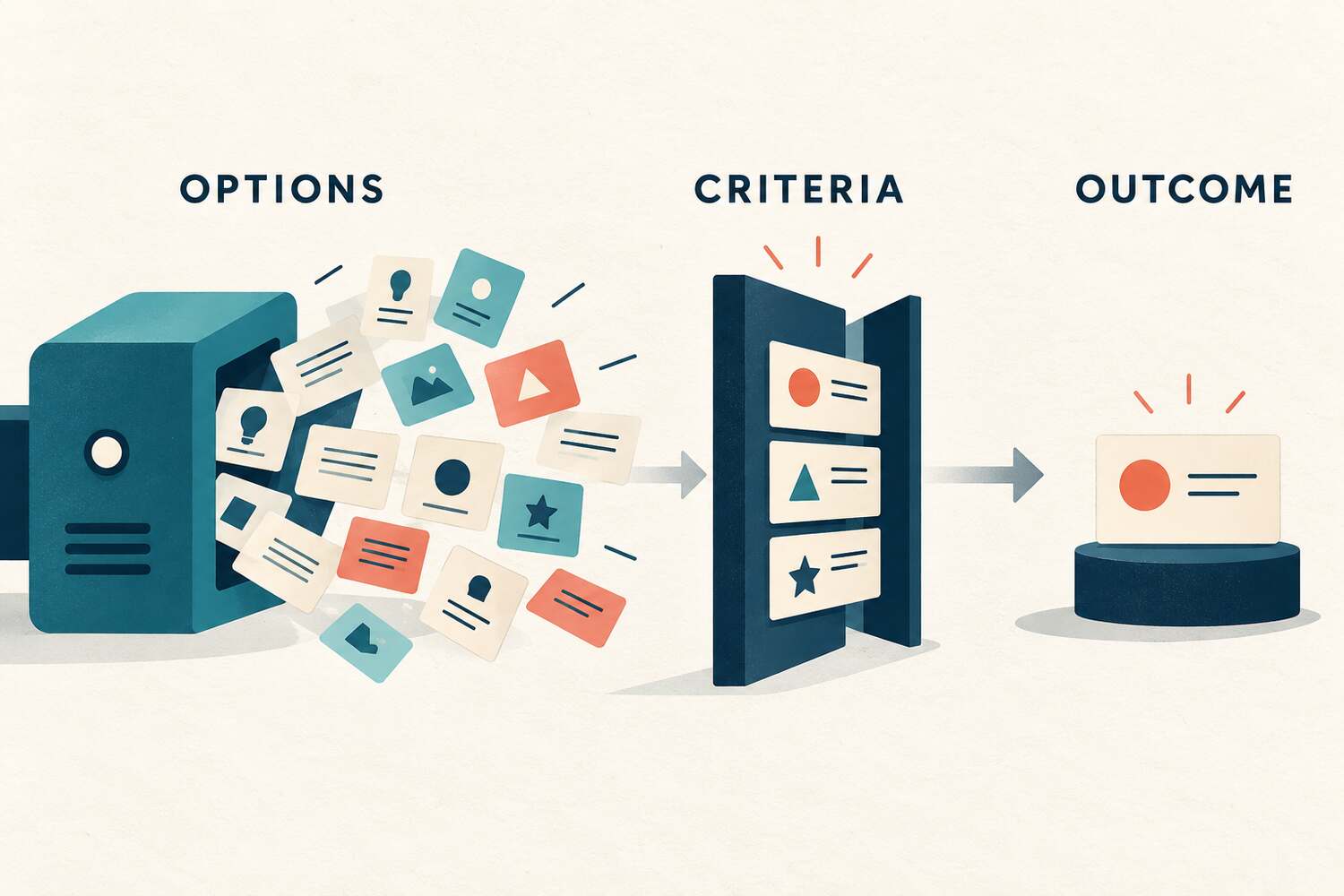
Generative AI can produce ten plausible options before a team has agreed what a good option must achieve. The visible cost of generation falls. The hidden cost moves to people: they must read, compare, verify, discuss and approve what the tool produced. More output is not the same as more progress.
This matters to business and AI leaders because option volume can look like momentum. A longer list, a fuller deck or five alternative plans may feel productive while consuming the same scarce decision attention needed to choose and act. The practical thesis is simple: set the decision criteria and an option limit before asking AI to expand the field.
Generation cost falls; consideration cost remains
NIST’s AI Use Taxonomy starts from human goals and outcomes. It treats AI activities as parts of a task rather than treating the model itself as the unit of value. The UK Government’s AI Playbook makes a related point: AI use cases should be led by business and user needs, pain points and inefficiencies—not by what the technology can do.
Those principles expose the missing line in many brainstorming prompts. “Give me fifteen ideas” specifies a quantity, but not the outcome, constraints or evidence that will separate a useful option from a polished distraction. The model can satisfy the request while handing the real work back to the team in a larger pile.
This is not an argument against exploration. Early options can reveal assumptions and widen a narrow brief. The problem begins when every generated possibility is treated as something a person must consider. The Government Project Delivery guidance on benefits starts from objectives and outcomes, then links possible solutions to the benefits they are expected to create. That sequence is a useful discipline for AI-assisted choices too.
The COST gate for AI-generated options
C — Criteria before creation
Write the outcome, hard constraints and evidence needed for a credible choice before generating alternatives.
O — Option cap
Ask for the smallest useful set. Three genuinely different routes are often more actionable than ten lightly varied ones.
S — Selector with authority
Name the person or group that will choose, and the deadline for choosing. Advice without a selector becomes an expanding discussion.
T — Terminate the extras
Record why the rejected routes stopped, then remove them from the active workflow. Do not keep every draft alive by default.
Worked example: one onboarding change, twelve plausible plans
Reading is a start. Practice makes it stick.
Start learningImagine a fictional operations team redesigning supplier onboarding. The desired outcome is to reduce avoidable rework while preserving compliance checks. A manager asks an AI tool for twelve improvement ideas. The result includes new forms, a chatbot, a knowledge base, an approval dashboard, automated reminders and several training variants. Every item sounds reasonable. None is ready for a decision.
The team restarts with the COST gate. It writes three criteria: the option must address the two most common sources of rework, fit the existing procurement system and be testable with one business unit in four weeks. It also names the procurement director as selector and caps the output at three routes that differ in mechanism, not wording.
| Option flood | COST-gated set | |
|---|---|---|
| Prompt | Generate twelve onboarding improvements | Propose three distinct routes against named criteria |
| Evidence | General rationale | Relevant workflow evidence and open assumptions |
| Decision owner | Unclear | Procurement director |
| End state | All ideas remain in circulation | One route selected; two closed with reasons |
The selected route is not automatically correct. It is simply ready for a real test. The team keeps the source evidence and unresolved assumptions beside it, then decides whether the pilot should scale, pause or stop. AI helped widen the field, but the decision system prevented option generation from becoming the work itself.
Teach pruning as an AI skill
Most AI training teaches people how to improve an answer. Leaders also need people who can reduce a set: identify duplicates, expose material differences, reject routes that fail a hard constraint and ask what evidence could reverse the choice. That is not less creative. It protects creative attention for the options that can change an outcome.
A good hand-off should therefore contain the chosen option, the criteria used, the evidence checked, the open assumption and the rejected routes with short reasons. Connect this discipline to a clear definition of done, a realistic review budget and a decision about what saved time should become. Leaders can use Bokili’s company learning approach to turn the same behaviour into short practice.
- Choose one open decision where AI has already produced several routes.
- Write the outcome and two hard constraints in one sentence.
- Circle the three options that are materially different; group or discard the rest.
- Name the selector and the evidence needed before the deadline.
- Close every rejected route with one reason, then move only the selected route into the workflow.
The competitive advantage is not an endless supply of drafts. Most teams can now get those. The advantage is the ability to decide what deserves attention, stop what does not and move one evidence-backed option into action. When options become cheap, disciplined consideration becomes more valuable.
Sources
- AI Use Taxonomy: A Human-Centered Approach — NIST
- Artificial Intelligence Playbook for the UK Government — UK Government
- Chapter 19: Benefits management — Government Project Delivery
Reading is a start. Practice makes it stick.
Bokili turns skills like this into ten-minute missions for your whole team, with instant feedback and progress you can see.
Start learningKeep reading
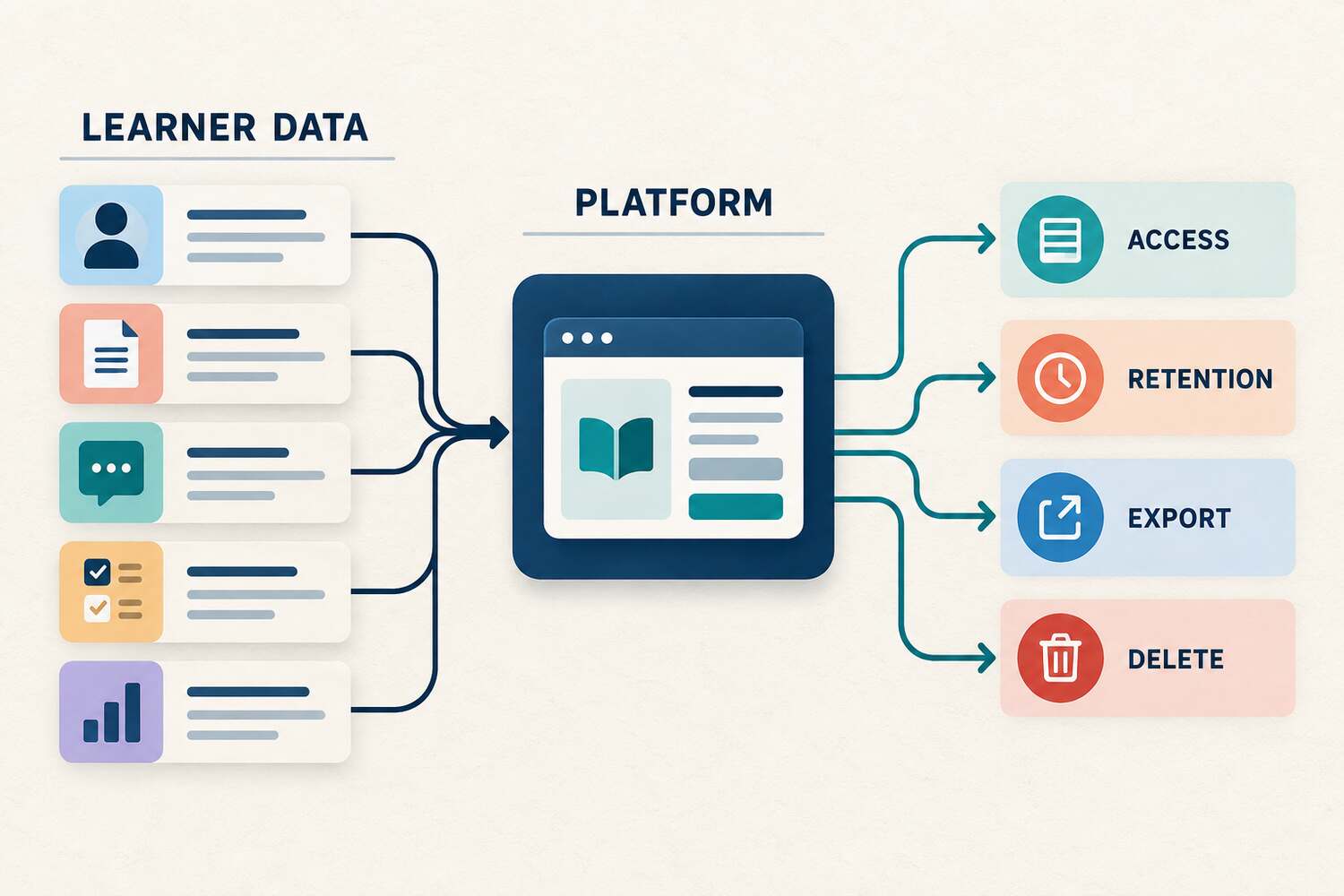
AI Training Platform for Companies: Map Learner Data Before You Buy
Before choosing an AI training platform for companies, map learner identity, work inputs, feedback, access, retention, export and deletion.

Corporate AI Training Needs an Exception Library
Corporate AI training should rehearse recurring boundary cases, so employees know when to proceed, pause for evidence or escalate.

Turn Customer Interviews Into Testable Product Hypotheses With AI
A four-stage evidence ladder helps product teams use AI without confusing interview observations, interpretations, hypotheses and tests.