
AI Literacy Training for Business: Teach the AI Work Handoff
AI literacy training for business should teach a short, risk-based handoff that makes the tool, inputs, AI contribution, checks and human owner visible.
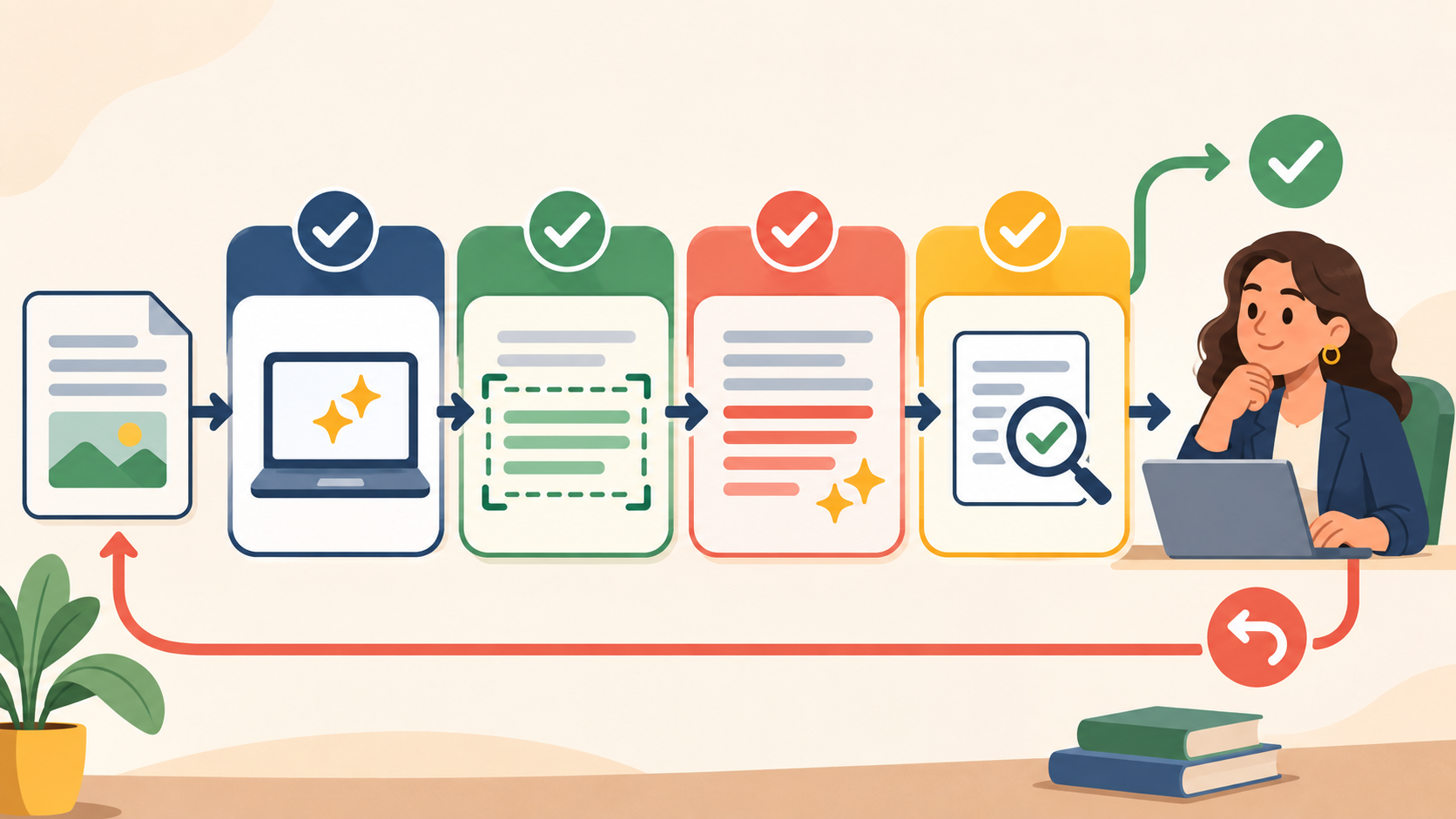
AI literacy training for business should teach employees how to hand off AI-assisted work, not only how to create it. A colleague receiving a draft needs to know what the tool contributed, which inputs were allowed, what a person checked and who owns the final decision. Without that record, reviewers either repeat the work or trust a polished output without seeing its limits.
The handoff is an internal work control, not a universal legal label. EU transparency rules apply to specific situations, including direct interaction with AI, deepfakes and certain public-interest text. A routine internal draft does not automatically require the same public label. Organisations should define a proportionate record for their own workflows and obtain qualified advice for legal duties.
AI literacy training for business needs a visible handoff
The European Commission’s current AI-literacy guidance says learning measures should reflect staff knowledge, experience, the system’s context and the people affected. It also says simply asking staff to read instructions may be ineffective. NIST’s AI Risk Management Framework playbook calls for clear human roles, documented oversight and current records. These principles become practical when employees can complete one small handoff at the point where work changes hands.
The TRACE handoff
T — Tool
Name the approved AI system or feature used. Do not write only “AI”; the reviewer needs enough detail to understand the workflow.
R — Reference boundary
State which approved sources or input types were used and which sensitive material was excluded. Do not copy confidential content into the record.
A — AI contribution
Describe what the system did: summarised, drafted, classified, compared or suggested. Separate that contribution from the employee’s edits and judgement.
C — Checks
List the material checks a person actually completed, such as opening citations, reconciling numbers or comparing the draft with policy.
E — Executive owner
Name the person or role that approves, rejects or acts on the work. The tool does not own the decision.
TRACE is deliberately short. It should travel with the work in the place colleagues already review it: a document note, ticket field, workflow card or approval comment. The record is not a confession and should not become a long prompt log. It gives the next person the minimum information needed to judge the work without reconstructing the whole session.
Match the handoff to risk
| Low-consequence draft | Decision-support work | |
|---|---|---|
| Example | Rewrite an internal meeting agenda | Compare supplier evidence for a shortlist |
| Handoff depth | Tool, contribution and owner may be enough | Add source boundary, material checks, uncertainties and approval route |
| Reviewer action | Check usefulness and tone | Open decisive evidence and challenge assumptions |
| Record | Short note beside the draft | Workflow record tied to the decision |
Do not force the same record onto every use. A grammar edit and a supplier recommendation have different consequences. Increase the handoff detail when the output affects people, money, access, rights, safety or public communication. Reduce it for reversible, low-consequence work that a colleague can easily inspect. The stable rule is that the record must support the reviewer’s next decision.
Worked example: an AI-assisted supplier brief
A procurement analyst uses an approved assistant to compare two supplier responses against a requirements sheet. The tool extracts claims and drafts a one-page comparison. The analyst then opens the source documents, corrects two mismatched dates and marks one security answer as unresolved. The brief goes to the procurement lead.
Reading is a start. Practice makes it stick.
Start learningA weak handoff says, “Drafted with AI—please review.” It names neither the evidence nor the human work. A useful TRACE note says: approved company assistant; requirements sheet and two supplier responses; AI extracted and compared claims; analyst checked every price, date and security statement against the originals; unresolved retention answer highlighted; procurement lead owns the shortlist decision.
Teach the handoff inside a real workflow
- 1
Choose one recurring handoff
Pick work that already moves from an AI user to a reviewer, such as a brief, analysis, draft policy or customer response.
- 2
Write the minimum TRACE fields
Use the smallest record that lets the reviewer understand the tool, source boundary, contribution, checks and owner.
- 3
Plant one gap
Give learners a source conflict, missing fact or unsupported claim so the exercise tests disclosure and escalation rather than fluent writing.
- 4
Review the record and the work
Ask the reviewer whether the handoff changed what they checked. If not, remove noise or add the missing decision cue.
- 5
Repeat with a fresh case
A second example shows whether the behaviour transfers beyond the trainer’s template.
The training evidence should be observable. Record whether the learner named the system, stayed inside the approved input boundary, described the AI contribution accurately, completed the required checks and left the decision with the correct owner. Attendance alone does not show any of those behaviours.
Keep public labelling and internal records separate
Article 50 of the EU AI Act contains transparency duties for defined cases. The Commission’s July 2026 guidance says certain public-interest text may be exempt from labelling when it has undergone substantive human review or editorial control; superficial spelling or grammar checks are not enough. That is a legal scope question, not a reason to treat every internal AI-assisted sentence the same way.
Control method, not legal advice
TRACE is a practical internal training framework. It does not determine whether a legal disclosure or public label is required. Confirm applicable duties with your legal or compliance owner.
A company may decide to keep a wider internal record than the law requires because it helps review, audit or learning. That is legitimate when the record is proportionate and does not expose sensitive prompts or personal data. Define retention, access and ownership. Do not collect a complete chat transcript by default if a five-line handoff is enough.
AI work handoff gate
- The approved tool or feature is named.
- The allowed source or input boundary is clear.
- The AI contribution is described with a concrete verb.
- Material human checks are listed honestly.
- Uncertainty and missing evidence remain visible.
- A person or role owns the final decision.
- The record contains no unnecessary confidential or personal data.
- Higher-consequence work follows the required review and escalation route.
- Choose one low-risk AI-assisted work product another person reviews.
- Write one line for Tool and one for Reference boundary.
- Describe the AI contribution with one verb and the employee contribution with another.
- List the two checks that matter most to the reviewer.
- Name the decision owner and one unresolved point.
- Ask the reviewer what the note changed about their review, then shorten or strengthen it.
Connect the handoff to a wider learning path
Use TRACE alongside Bokili’s role-based AI literacy design at https://bokili.com/en/learn/risk-based-ai-literacy-training, the whole use-case chain at https://bokili.com/en/learn/ai-literacy-training-business-use-case-chain and the three authority levels at https://bokili.com/en/learn/ai-literacy-training-business-authority-levels. For team rollout, Bokili’s HR and L&D page at https://bokili.com/en/for-hr shows how short, role-adapted missions can turn the rule into practice.
Good AI literacy makes responsibility easier to see at the moment work moves. Teach employees to leave a small, accurate TRACE record. Reviewers can then inspect the right evidence, decision owners can act with context and the organisation can improve the workflow without pretending every use carries the same risk.
Practise this in Bokili
Turn what you just read into a ten-minute mission.
- Start learning
Build risk-based AI literacy training
Match practice depth to role, system and consequence.
- Start learning
Teach three levels of AI authority
Define whether AI may advise, prepare or act in each workflow.
Sources
- AI Literacy — Questions & Answers — European Commission
- Transparency obligations under Article 50 of the AI Act — European Commission
- Govern Playbook — NIST AI Resource Center
- Artificial Intelligence Playbook for the UK Government — UK Government
- AI training for HR & L&D leaders — Bokili
Reading is a start. Practice makes it stick.
Bokili turns skills like this into ten-minute missions for your whole team, with instant feedback and progress you can see.
Start learningKeep reading

AI Training for HR: Keep Health Inference Out of Absence Summaries
Train HR teams to produce a minimal operational absence summary without exposing health details, inventing causes or letting AI make a people decision.

Allocate AI Licences to Task-Ready Work, Not Waiting Lists
Use four readiness gates to allocate scarce AI access to work with an approved input, clear outcome, review owner and support route.

AI Skills for Employees: Calibrate Confidence Before Checking
Train employees to record confidence before AI advice, verify the decisive claim and learn from the gap between prediction and evidence.